
For decades, the liquid food packaging industry has operated under a rigid technical constraint: if you required high-barrier performance for oxygen-sensitive products, recyclability was the first thing you had to sacrifice.
Traditional approaches to protecting sensitive liquids such as wine, dairy, sauces, and liquid eggs – within flexible Bag-in-Box formats relied on metallized films, aluminum foil layers, or complex multi-material laminations. These structures, combining PET, Nylon, and Polyethylene, were effective at maintaining product integrity, but they were a recycling nightmare. Because these layers cannot be economically separated, they often end up in landfills or contaminate pure recycling streams.Today, that trade-off is no longer acceptable. With the integration of the EU’s Packaging and Packaging Waste Regulation (PPWR), the landscape has shifted from voluntary sustainability to mandatory compliance.
The Regulatory Horizon: PPWR and the 2030 Mandate
The PPWR, which began its general application in 2025, has fundamentally redrawn the boundaries for global suppliers. The regulation is clear:
- By 2030: All packaging placed on the EU market must be recyclable.
- By 2038: Only packaging achieving the highest recyclability grades (A and B) will be permitted.
For flexible packaging producers, this is not a minor adjustment; it is a structural challenge. For Bag-in-Box applications specifically, the challenge is acute. We aren’t talking about small dry-food pouches; we are dealing with 3-to-20-liter formats that must withstand immense hydrostatic pressure while maintaining a total oxygen barrier for months.
Why Mono-Material for Liquids Took So Long to Solve
While mono-material pouches for dry snacks have reached commercial maturity, liquid formats lagged behind due to three critical failure modes:
- Flex-Crack Failure: During transportation, the constant sloshing of liquid creates stress on the film. Traditional mono-PE films often developed microscopic pinholes (flex-cracks), compromising the barrier.
- Oxygen Ingress at the Fitment: In Bag-in-Box, the connection between the bag and the spout is a high-risk zone. Engineering a mono-material bond that remains airtight during and after dispensing requires precision molding and heat-sealing expertise.
- The EVOH Paradox: To stop oxygen, you need EVOH. But too much EVOH makes the bag “multi-material” and unrecyclable.
The industry’s design window is narrow: a structure must contain over 95% Polyethylene (PE) to be accepted as grade A in standard recycling streams. This is the exact window where Aran Group’s R&D team focused their efforts.
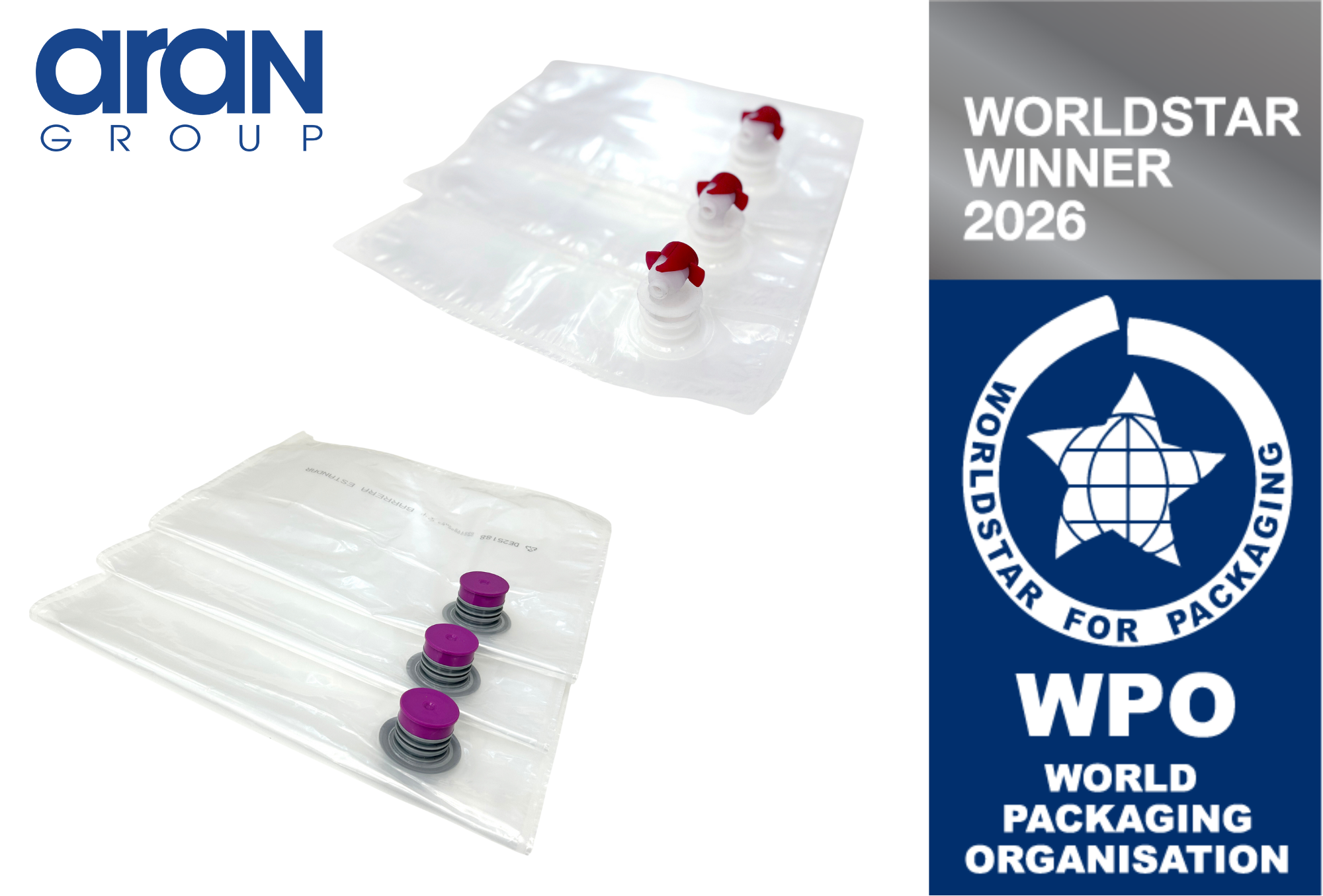
Introducing MonoFlex: WPO WorldStar 2026 Winner
Aran’s MonoFlex is not just a new product; it is a validated engineering breakthrough. By utilizing advanced co-extrusion and lamination technologies, we have created a high-barrier structure that could be recycled as a single polymer.
Technical Performance Breakdown
| Feature | MonoFlex Performance | Technical Advantage |
| Polymer Composition | >95% Pure PE | Compatible with standard PE recycling streams (Class A) |
| Barrier Technology | Ultra-thin EVOH layer | Superior OTR (Oxygen Transmission Rate) for 12+ months |
The Fitment Advantage
A bag is only as good as its spout. MonoFlex features an integrated fitment system designed to minimize oxygen pickup during the dispensing process. This is particularly critical for the wine and condiment industries, where the product must stay fresh for weeks after the first glass or serving is poured.
Operational Excellence and Global Supply
Choosing MonoFlex is a strategic decision that affects the entire value chain. Beyond the environmental benefits, it offers:
- Source Reduction: MonoFlex is significantly lighter than rigid plastic or glass containers, leading to a massive reduction in “Scope 3” transport emissions.
- Global Certification: Aran maintains a global network of production sites (Israel, Spain, USA) and holds ISO 9001:2018, ISO 14001 and BRC/IOP certifications.
Frequently Asked Questions
Q: What makes MonoFlex different from traditional Bag-in-Box solutions?
A: Unlike traditional formats that rely on non-recyclable metallized films or complex multi-material laminates, MonoFlex is engineered as a mono-material PE solution. By using a minimal EVOH layer (less than 3%), it maintains high-barrier protection for oxygen-sensitive products without compromising the bag’s recyclability.Q: Is MonoFlex fully recyclable and PPWR compliant?
A: Yes. MonoFlex is specifically designed for recyclability within standard polyethylene (PE) streams. It complies with “A” rating under the European Packaging and Packaging Waste Regulation (PPWR) guidelines, making it a future-proof solution for the 2030 and 2038 sustainability mandates.Q: Which products and applications is MonoFlex suitable for?
A: MonoFlex is ideal for a wide range of oxygen-sensitive liquid foods, including wine, dairy, and liquid eggs. It is also highly effective for high-acid condiments such as ketchup, mayonnaise, and balsamic vinegar, as the inner PE layers are chemically inert and resistant to delamination or barrier degradation.Q: How does MonoFlex contribute to a company’s sustainability goals and ESG reporting?
A: By transitioning to a Class A recyclable material, companies can document a measurable reduction in non-recyclable waste. Additionally, MonoFlex’s lightweight flexible design reduces packaging volume compared to rigid containers, leading to lower carbon emissions across the global supply chain and improved ESG performance.
Q: What sizes are andavailable and is MonoFlex compatible with existing machinery?
A: We offer MonoFlex in formats ranging from 3 to 20 liters, catering to both retail and foodservice industries. A key advantage of MonoFlex is its full compatibility with standard Bag-in-Box filling machinery, allowing for a seamless transition to sustainable packaging without requiring new operational investments.Conclusion: Engineering the Future of Liquid Packaging
The PPWR’s timeline is a defined horizon, but the real constraint is technical. At Aran Group, we believe that sustainability shouldn’t come at the cost of performance. MonoFlex is proof that through material science and a commitment to “Design for Recycling,” we can protect both your product and the planet.As a global leader in Liquid Packaging Solutions, we invite you to join the circular economy.
Ready to future-proof your packaging? Contact our team today for a technical consultation.

