
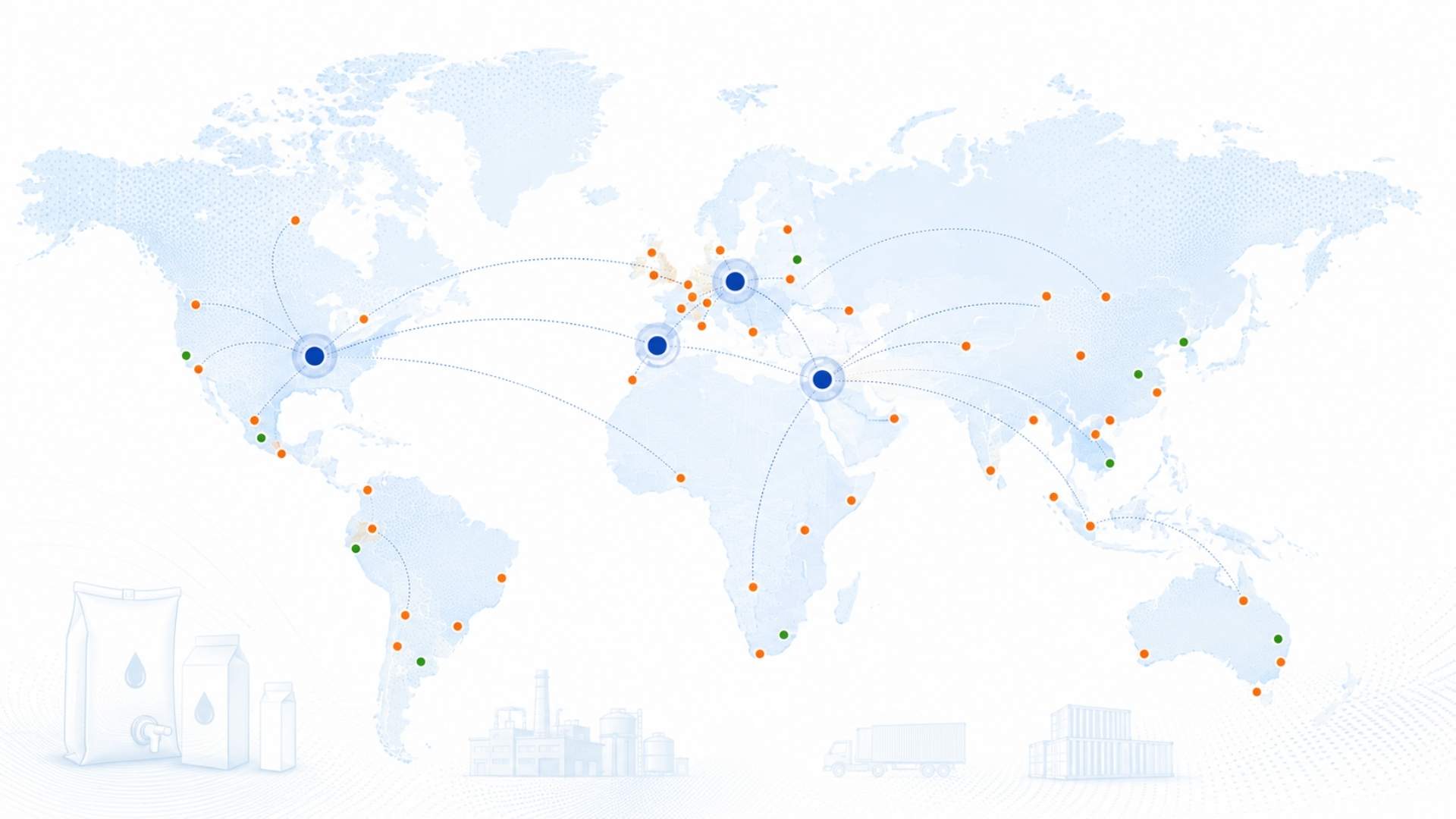
For most of the last two decades, scale was the organizing logic of global packaging. Consolidate production, concentrate capability, ship from fewer and larger sites, and let unit economics do the rest. That logic held as long as global logistics were cheap, predictable, and politically uneventful. None of those three conditions can be assumed today.
The result is a quieter shift in how manufacturing footprint is evaluated. A footprint is still often read as a measure of market presence. Its more consequential function, though, is operational: it determines how production and technical capability are physically distributed against regulatory variability, fragile supply chains, and region-specific customer requirements. Where those capabilities sit has become a question of resilience, not just reach.
Aran Group operates four production sites – in Israel, the United States, Spain, and Germany – and, together with a global distributor network, serves more than 60 countries. The structure is deliberately not a scale-driven expansion. It functions as a distributed manufacturing and engineering system, placing production and technical interfaces closer to demand so that the specifications, compliance standards, and logistical constraints of each market can be managed where they actually arise.
Regulatory alignment is not a global pathway
In aseptic packaging, global consistency is only half the operational framework. The other half is alignment with regional regulatory systems and validation protocols – and there is no single pathway that governs it.
Aseptic solutions depend on coordination with multiple irradiation centers, and validation requirements differ meaningfully by region. A sterilization dose and protocol accepted in one jurisdiction does not automatically transfer to another; the validation has to be established against the relevant regional framework. Aran Group works with a network of roughly seven irradiation facilities, which allows that regional alignment to happen without compromising a consistent product-integrity standard across markets.
This is the operational reality of long shelf-life dairy and liquid food: regulatory frameworks are fragmenting, not converging. A distributed model is not a marketing posture toward that fragmentation. It is the only practical way to meet it without forcing every market through a single, slow, centrally validated channel.
Proximity changes supply chain behavior
Manufacturing close to end markets does not simply shorten shipping distance. It changes how the supply chain behaves.
Liquid food demand is driven by production schedules, seasonal shifts, and retail-level variability far more than by stable long-range forecasts. A centralized model absorbs that variability through inventory and lead time – both of which became liabilities as freight costs, energy prices, shipping-route reliability, and raw material availability turned volatile over recent years. Geopolitical instability and regional conflict have made long cross-border supply lines a structural risk rather than an efficiency.
A distributed model reduces that exposure. It shortens the distance between a specification change and its execution on the line, which matters most precisely where packaging performance is tightly coupled to filling stability and shelf-life integrity. When a customer adjusts a format or a filling parameter, the question is whether the response cycle is measured in days against a nearby site or in weeks against a distant one. Under disrupted logistics, that difference is the difference between continuity and a stoppage.
Technical support sits where production does
The same distribution applies to engineering. Process consultation, application support, and on-site evaluation are positioned regionally rather than routed through a single hub.
This matters because production problems do not appear under controlled assumptions. They appear on a running line, under real material, ambient, and throughput conditions – and a deviation in a food environment can compromise product integrity or halt production within a single shift. When the engineer who can read the problem is regionally present rather than several time zones and a flight away, response time stops being a service metric and becomes an operational input. The distributor network functions as an extension of this same system: it carries field feedback from real applications back into production and design assumptions, so that what is learned in one market informs the engineering baseline across others.
The trade-off worth naming
A distributed model is not free of tension. It forgoes some of the unit-cost advantage of full consolidation and demands far tighter discipline to hold consistency across sites – unified engineering specifications, controlled material systems, and standardized validation, maintained simultaneously in four places rather than enforced from one. That is a real cost, and it is a defensible one. The question every global food manufacturer is now weighing is the same: how much concentration efficiency is worth surrendering in exchange for resilience when the next disruption – and there will be one – arrives.
Footprint, in other words, is no longer a map of where a company has chosen to sell. It is increasingly a statement of how it intends to keep operating when the conditions that made consolidation attractive no longer hold.
Distributed vs. Centralized Manufacturing in Liquid Food Packaging
| Comparison Parameter | Distributed Model – Aran Group | Centralized Model |
|---|---|---|
| Response Time | Measured in days, with regional proximity supporting operational continuity. | Often measured in weeks, with greater exposure to logistics and shipping volatility. |
| Regulatory Alignment | Agile and regionally aligned with local frameworks, validation protocols, and irradiation centers. | Slower, often dependent on a single centrally validated pathway. |
| Technical Support | Regional presence enables faster on-site or near-site troubleshooting on running production lines. | Remote support may be delayed by distance, time zones, and travel limitations. |
| Supply Chain Continuity | Reduces dependency on long cross-border supply routes and centralized inventory buffers. | Higher dependency on long-distance shipping, inventory planning, and freight stability. |
| Customer Adaptation | Enables faster response to specification changes, formats, and filling-line requirements. | Changes may require longer coordination cycles across centralized production systems. |